
Meter as a Service for African utilities
Sell every kilowatt-hour.Deliver it to the meter.Prove it arrived.
Mitar sends every prepaid sale to the customer’s meter and reads the meter’s answer. A sale is finished only when the meter confirms it has the credit, and your books show which sales are confirmed.
- One monthly fee per connected meter
- No upfront meter purchase
- Start on one feeder
01 The problem
Many utilities struggle to see, collect and secure what they sell.
These are not our numbers. They come from the World Bank and a national regulator, and they explain why a meter that confirms every sale matters.
of the 67 Sub-Saharan utilities studied cannot cover their operating and debt-service costs from revenue. 1
of billed revenue was collected by Nigeria’s distribution companies in Q2 2025. 2
of Nigeria’s active registered customers were metered at 30 June 2025. 2
In a World Bank model of 15 loss-making Sub-Saharan utilities, cutting system losses to South Africa’s level (about 11 to 12%) lets only 3 cover their operating costs. Cutting losses to that level and collecting every bill lets 9. A modelled scenario, not a measured result. 1 Nigeria is the best-documented example, not the whole continent.
02 The model
Stop buying meters. Start buying a working service.
In a Meter as a Service agreement the utility keeps its customers, its revenue and its tariff decisions. Mitar arranges the meters through its partners and provides the radio network, the software and the day-to-day operation as one service.
- Upfront investmentCapital spend on meters, installation, meter-reading software and integration.No upfront meter purchase: a monthly service fee per connected meter.
- Getting startedLong procurement before any field evidence.Field evidence first: a time-limited pilot on one feeder, within your procurement and regulatory rules.
- Who runs itThe utility hosts, staffs and maintains the platform.Mitar runs the platform and the radio network. The utility’s teams use it.
- AccountabilityThe utility carries the technology and performance risk.Risk is shared: service levels are agreed in the contract.
Cash committed over time
03 How it works
From payment to power, with proof at every step.
A sale counts as finished only once the meter confirms it has the credit, not when the money is collected. That is what makes every sale a proof of delivery.
The customer pays
At an agency counter or through a retail provider.
The sale is recorded
Written to the ledger with the tariff rate used.
The credit is encrypted
Packed into an AES-128 command for that one meter.
The credit is sent
Over LoRaWAN, through the gateway, to the meter.
The meter confirms
Only then is the sale marked delivered.
The receipt is issued
Its QR code shows whether it is valid or voided.
04 The platform
One console, with a view for every job.
Seven roles work from the same live data, and each sees only what its role and agency allow. These screens come from a demonstration environment filled with fictional data. Payment methods such as Mobile Money or Card are labels an agent records for money collected at the counter; no payment operator is connected.
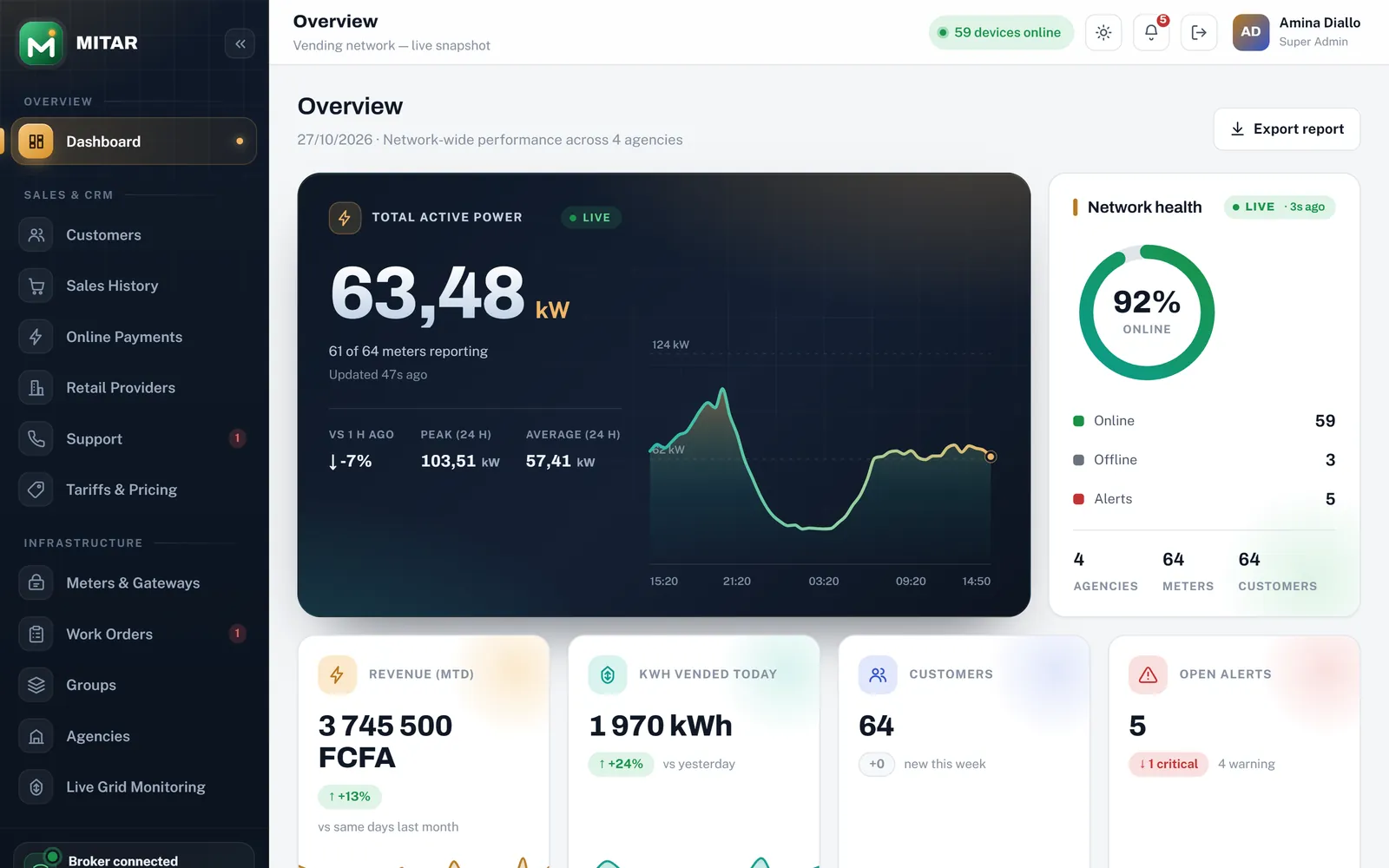
The whole network in one overview
- Total active power from every meter that reports, with a 24-hour curve
- Meters and gateways online, open alerts and the day’s sales
- Users, agencies, tariffs and settings in one place
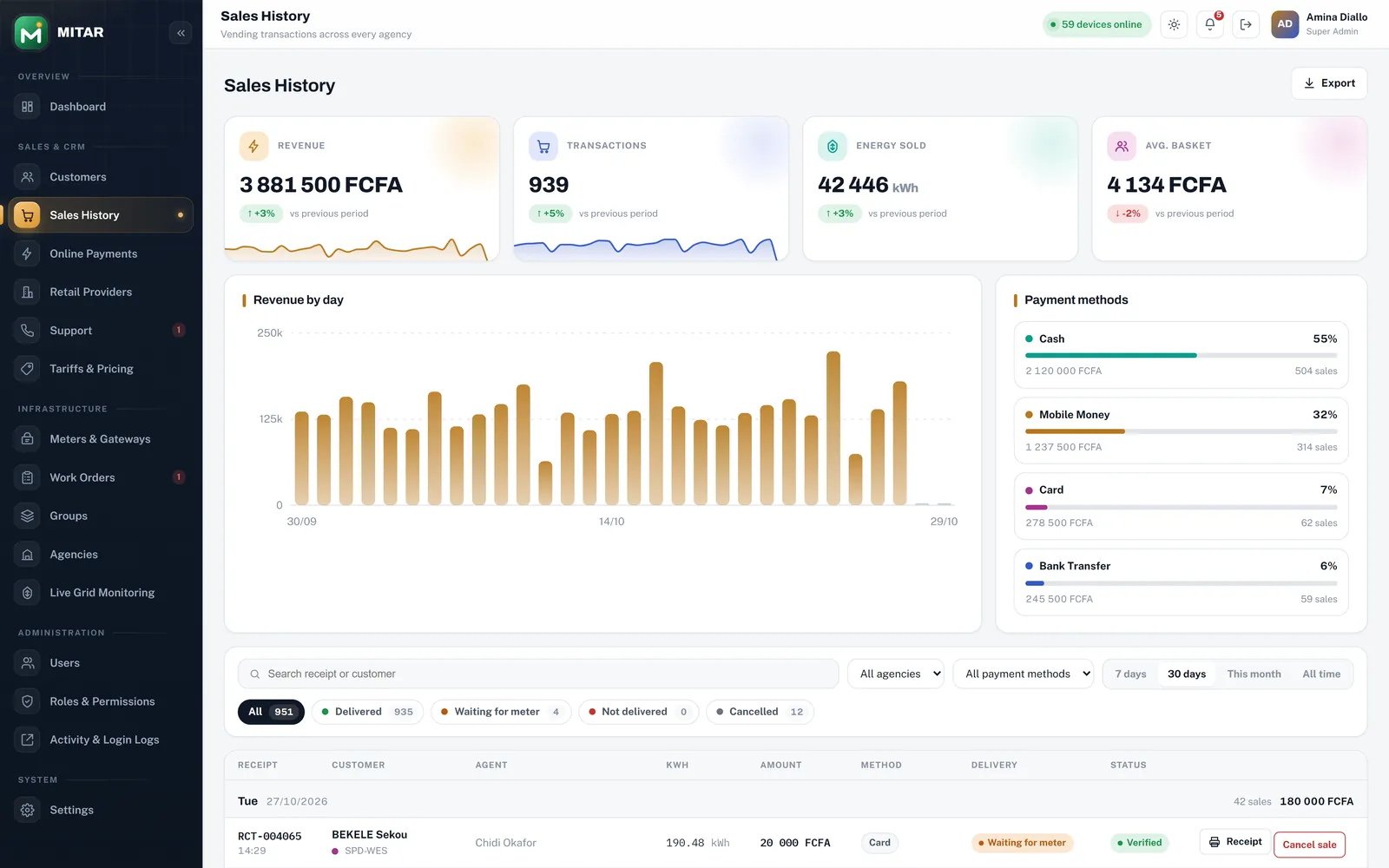
Every sale, delivered and receipted
- Delivered, waiting for the meter or cancelled: the status of each sale is always visible
- Print a two-copy receipt with a QR code, or reprint an old one, marked as a reprint
- Sales agents see only their own agency’s customers and sales; this overview is the administrator’s
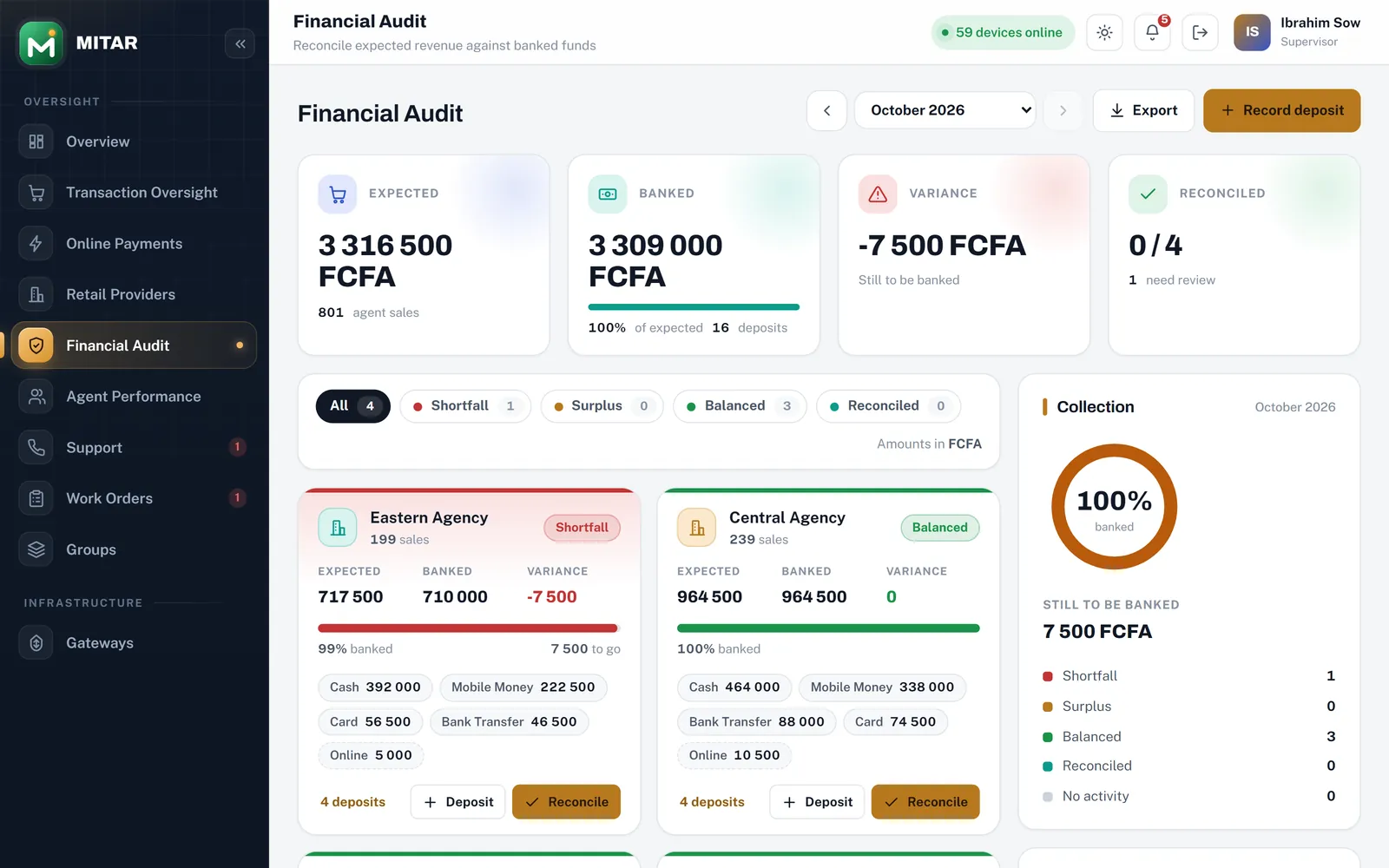
Know what was sold, delivered and banked
- Expected cash from recorded sales, compared with deposits recorded from bank statements
- The variance by agency and month, with a supervisor’s sign-off
- Flag, verify or cancel any transaction
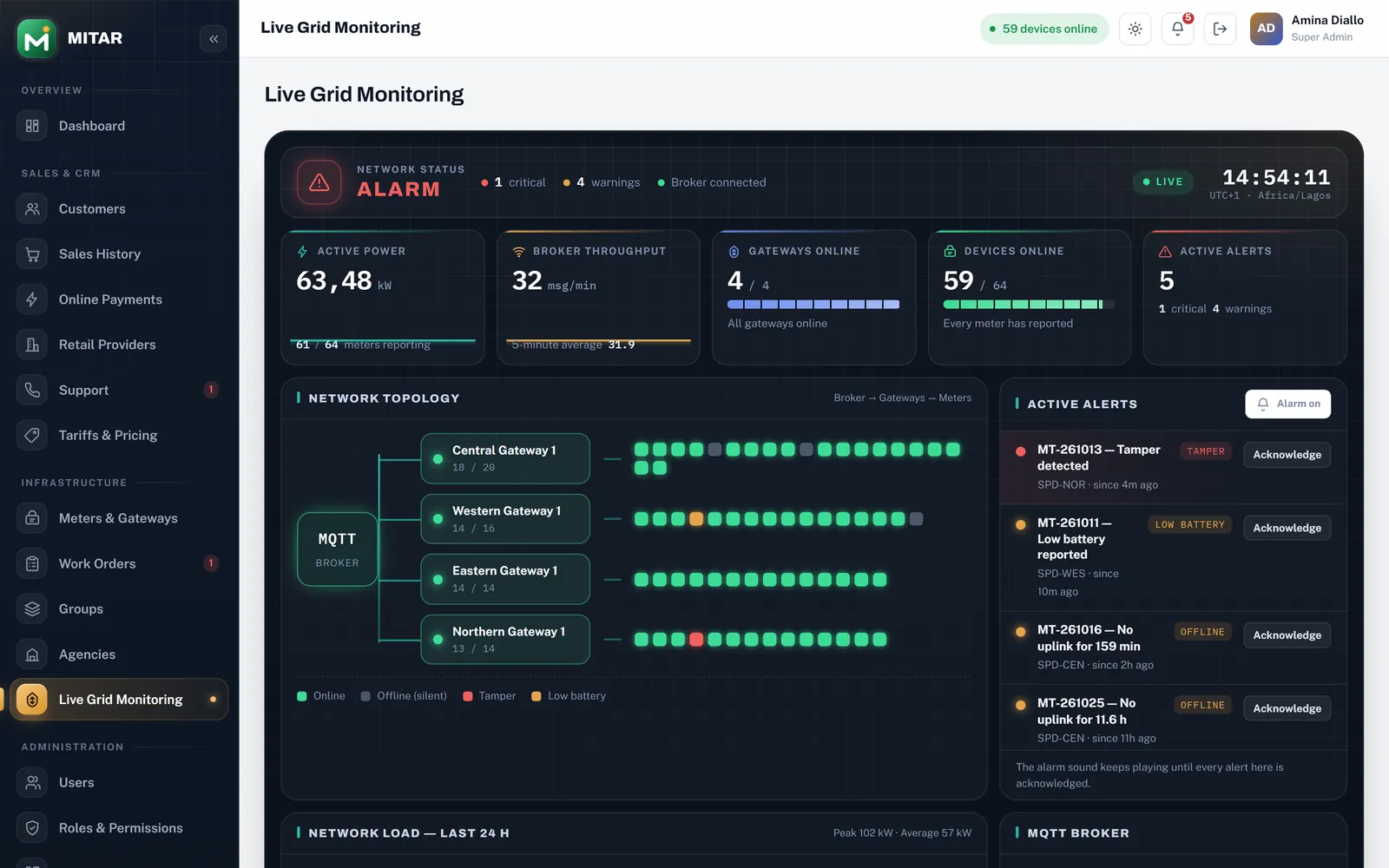
See the network breathe
- Which meters and gateways are online, and the power they draw
- Alerts for offline devices and meter alarms, with acknowledgement
- Cut or restore supply for a group of meters, with a preview and a recorded reason
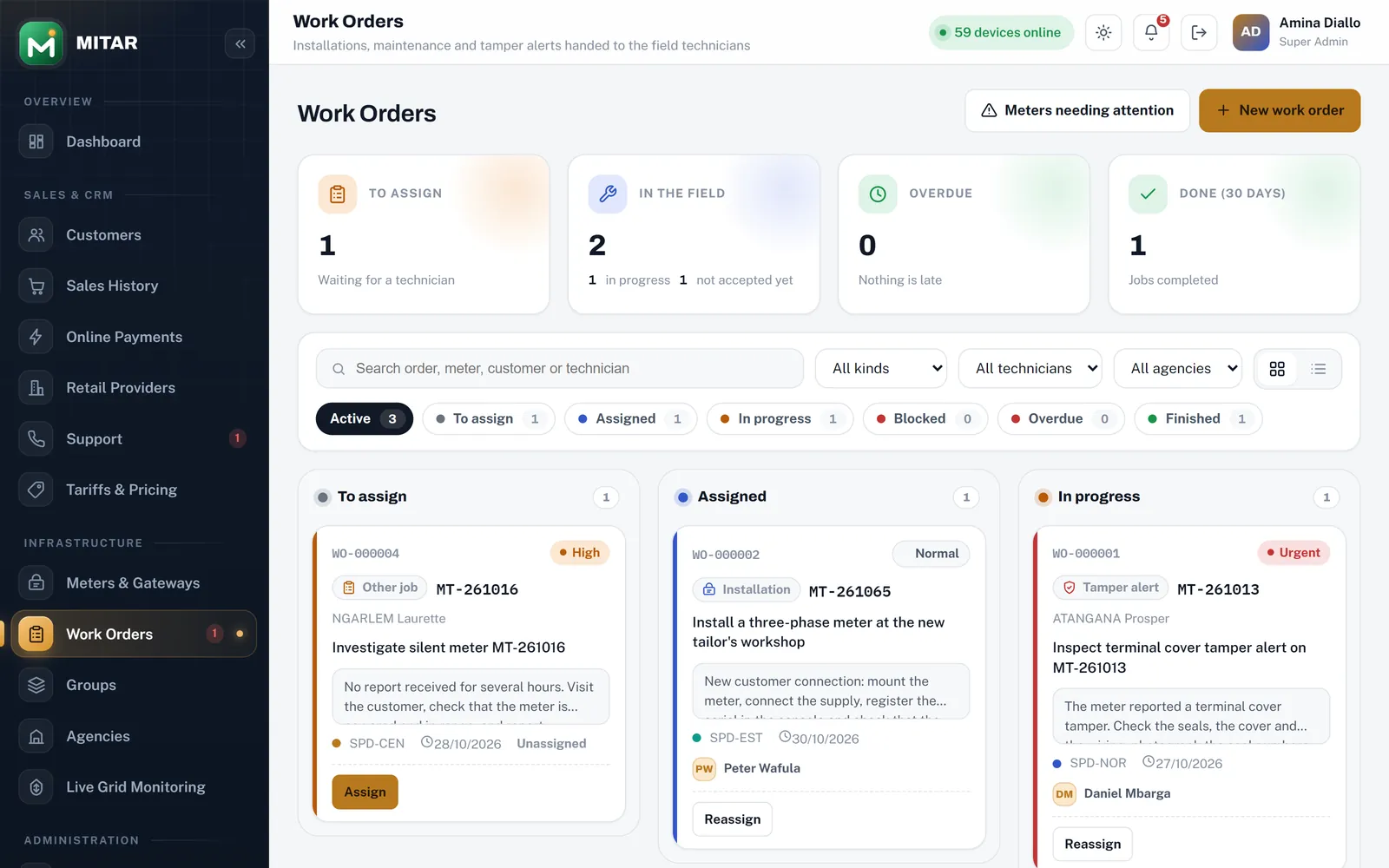
Jobs with a full timeline
- Installations, maintenance and inspections assigned to technicians
- Accept, start, block or complete: each step is logged
- Linked to the meter and the customer. Technicians see only their own jobs; this board is the administrator’s
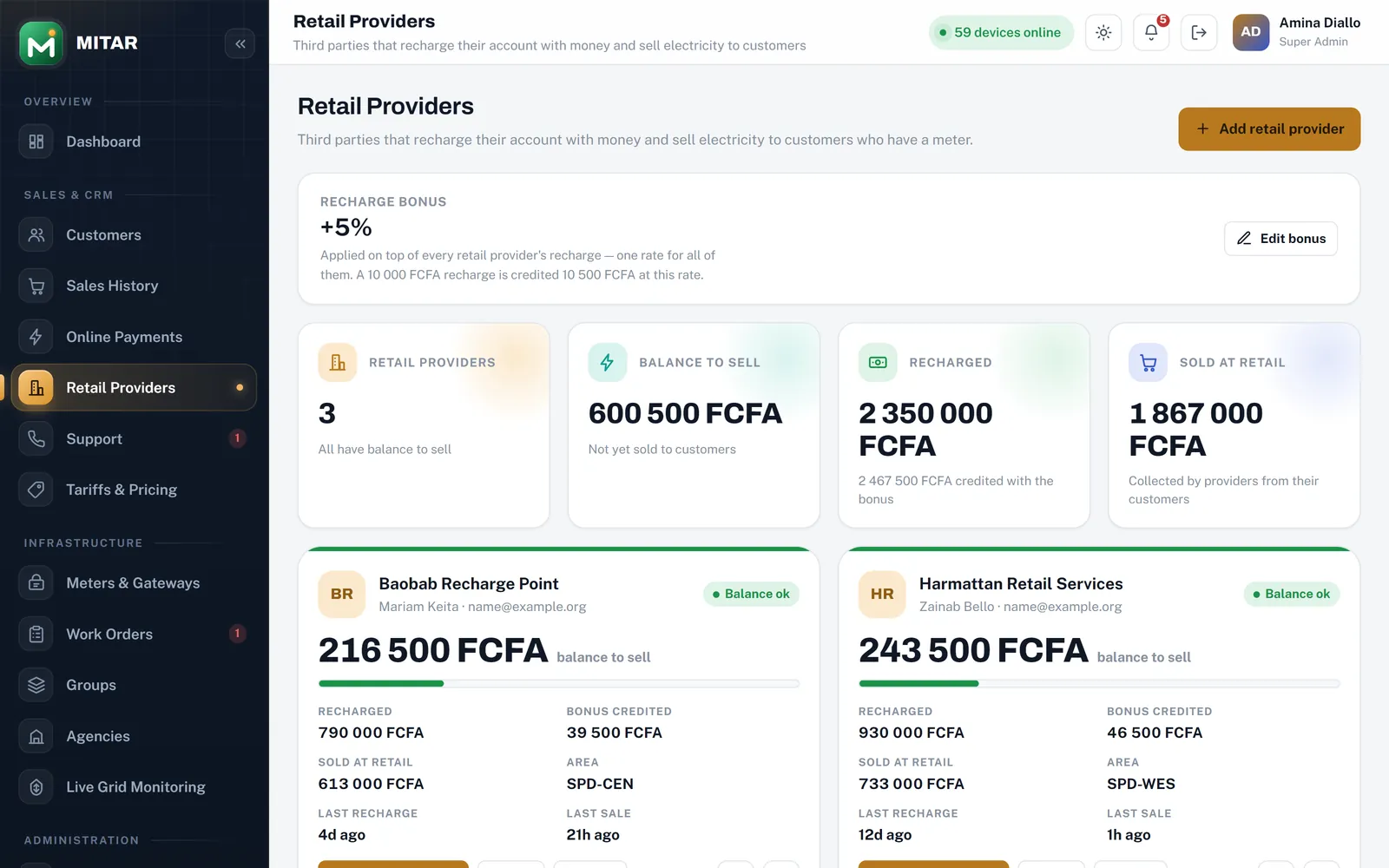
Retail providers with a prepaid balance
- Retail providers pay in advance; your staff record the recharge, with one bonus rate you set
- They sell to customers who have a meter until the balance runs out
- A receipt for every recharge, signed by the provider; this page is the administrator’s view
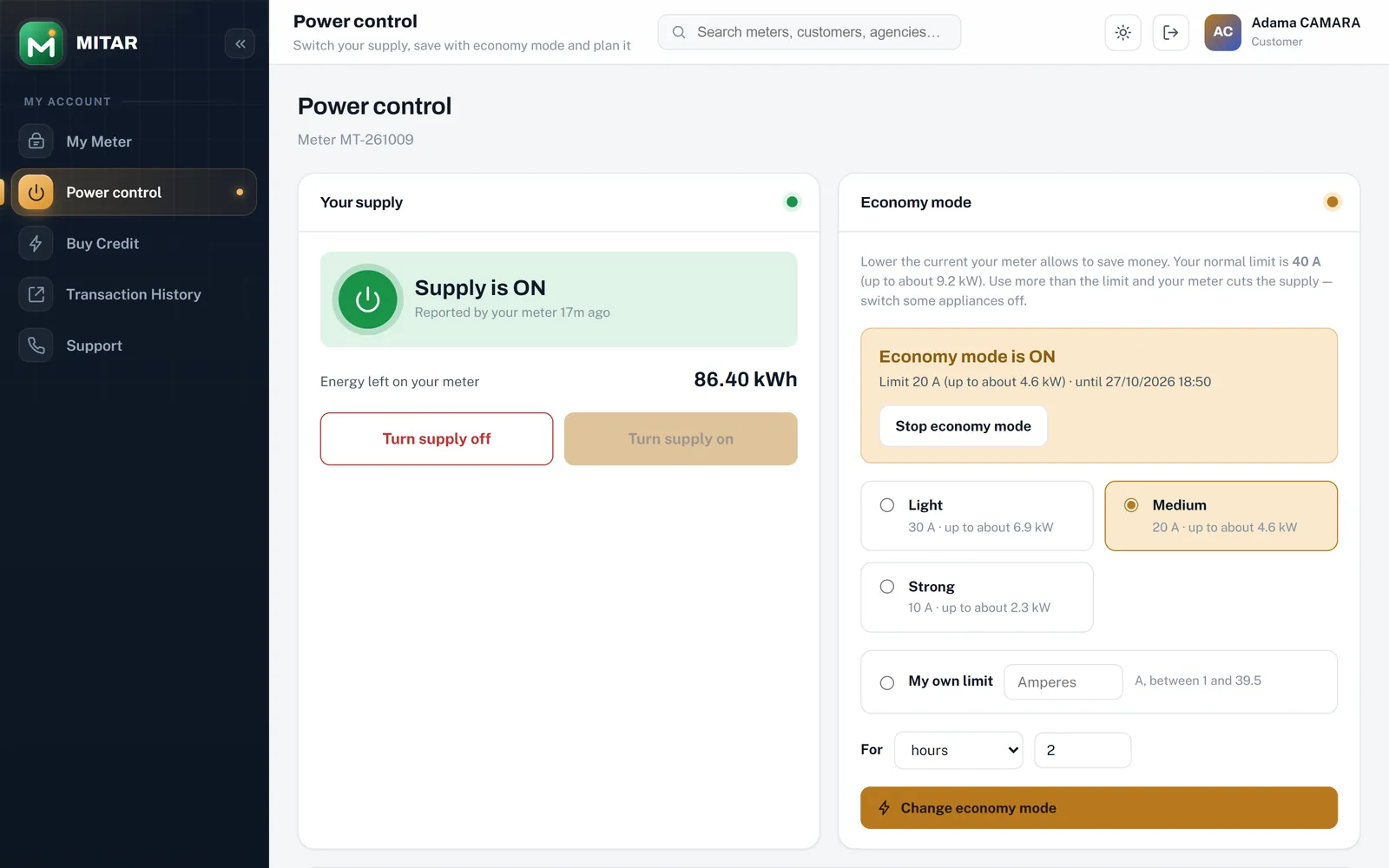
Customers in control
- Switch the supply off and on; the platform refuses to switch it on when no energy is left
- Economy mode and weekly plans cap the current for the hours the customer chooses
- Purchases and on-screen receipts in English, French, Spanish or Arabic; the printed sale receipt stays in English
05 Where things stand
What works today, and what does not yet.
Here is exactly what the platform does now, what is being tested, what comes next and what it does not do.
Live today
- Prepaid credit sent to the meter and confirmed by the meter
- Cancellation that takes the credit back from the meter
- Agency counters, retail providers and a customer portal
- Live grid view, remote relay control and meter groups
- English, French, Spanish and Arabic
In test
- A customer mobile app (Android test version)
- Online buying by customers: built and tested in a sandbox. No payment operator is connected yet
- Credit delivery to three-phase meters: built, not yet confirmed on a real three-phase meter
Next
- Mobile money and card operators, market by market
- Broader meter support
- Interfaces for partners and integrators
Not today
- Connecting to STS or DLMS meter fleets
- Billing or ERP connectors: sales data exports to Excel or CSV
- Tiered or time-of-use tariffs: flat per-kWh rates by customer segment
- Independent security testing and certification
06 The pilot
Start small and judge it on the facts.
We suggest testing the model on one feeder for about 90 days. The weeks start once the pilot agreement, the meter approval route and the meters on site are in place.
Discover
- Choose the feeder
- Survey radio coverage
- Set up agencies, tariffs and roles
- Record your baseline
Deploy
- Install LoRaWAN gateways
- Commission meters and link them to customers
- Train agents and technicians
Sell
- Run live prepaid sales end to end
- Confirm credit on each meter
- Compare sales with recorded deposits
Review
- Review results against the agreed indicators
- Present a summary built on your own data
- Decide: stop, extend or scale
Start with one feeder.
Let us show you Mitar working on real meters, and design a pilot for your network.
Where the numbers come from
- G. Timilsina, What Underlies the Poor Financial Performance of Electric Utilities in Sub-Saharan Africa?, World Bank Policy Research Working Paper 11257 (November 2025). 67 vertically integrated and distribution utilities in 47 countries; counterfactual modelling in section 4.1.
- Nigerian Electricity Regulatory Commission (NERC), Second Quarter 2025 Quarterly Report. Collection efficiency 76.07% (₦564.71 billion collected of ₦742.34 billion billed); of 11,821,194 active registered customers, 6,422,933 were metered at 30 June 2025.